How to Increase Authorized Share Capital of a Company in India (Complete Guide 2026)
 LegalGlobe
increase authorized share capital
🔹 Introduction
Authorized Share Capital is the maximum capital a company is legally allowed to issue to shareholders. As your business grows, you may need to increase this limit to raise more funds or issue new shares.
Under the Companies Act, 2013, increasing authorized share capital is a structured legal process involving Board approval, shareholder consent, and ROC filing.
In this complete guide, you’ll learn the step-by-step process, documents, fees, and expert tips.
🔹 What is Authorized Share Capital?
Authorized Share Capital is the maximum amount of share capital mentioned in the MOA (Memorandum of Association).
👉 Example:
If your company has ₹1,00,000 authorized capital, you cannot issue shares beyond this limit unless you increase it.
🔹 When Should You Increase Authorized Capital?
You should increase it when:
✔ You want to issue new shares
✔ You are bringing in investors
✔ Your paid-up capital is nearing the authorized limit
✔ Business expansion requires funding
🔹 Legal Provision
👉 As per Section 61 of Companies Act, 2013, a company can increase its authorized share capital if permitted by its Articles of Association (AOA).
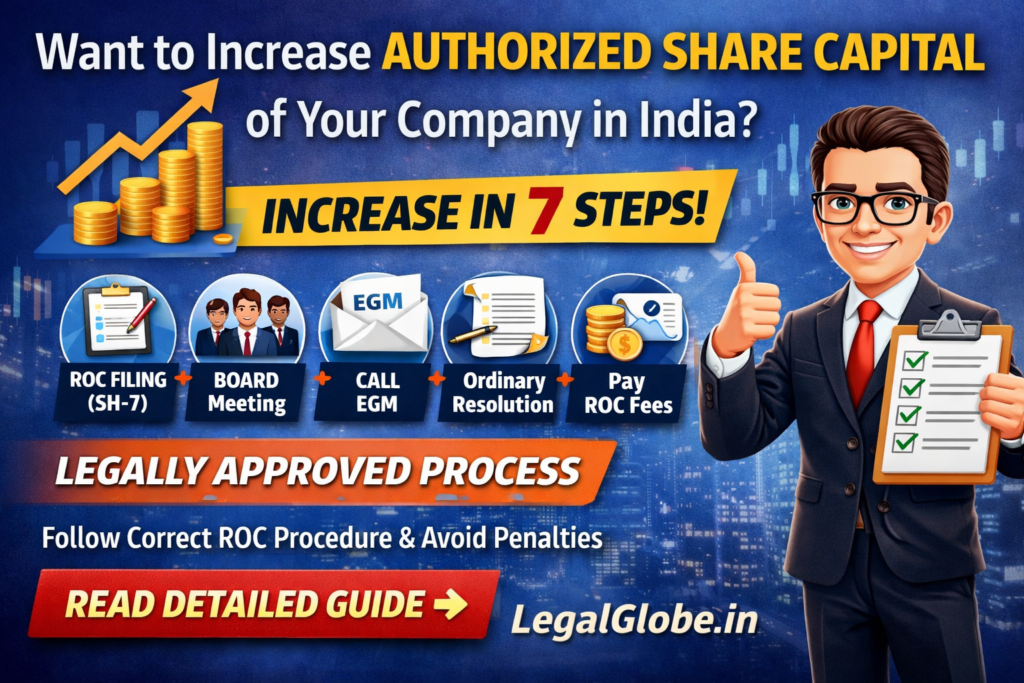
🔹 Step-by-Step Procedure
✅ Step 1: Check AOA (Articles of Association)
- Ensure AOA allows increase in authorized capital
- If not, first amend AOA
✅ Step 2: Conduct Board Meeting
Pass Board Resolution for:
- Approval of increase in capital
- Fixing EGM date
- Approving notice of EGM
✅ Step 3: Issue Notice of EGM
- Send notice to shareholders (21 days clear notice)
- Shorter notice allowed with consent
✅ Step 4: Pass Ordinary Resolution
In EGM:
- Approve increase in authorized capital
- Alter Capital Clause of MOA
👉 Relevant section: Section 13 of Companies Act, 2013
✅ Step 5: File Form SH-7 with ROC
- File within 30 days of resolution
- Submit on Ministry of Corporate Affairs portal
📌 Attachments:
- Certified copy of Ordinary Resolution
- Altered MOA
- Notice of EGM
✅ Step 6: Pay ROC Fees & Stamp Duty
- Fees depend on amount increased
- Stamp duty varies by state
✅ Step 7: ROC Approval
- ROC verifies documents
- Authorized capital gets updated in MCA records
🔹 Documents Required
✔ Board Resolution
✔ Ordinary Resolution
✔ Altered MOA
✔ Notice of EGM
✔ AOA (if amended)
🔹 Example
👉 Current Authorized Capital: ₹1,00,000
👉 Increased to: ₹10,00,000
➡ Increase Amount = ₹9,00,000
➡ ROC fees applicable on ₹9,00,000
🔹 ROC Fees (Basic Idea)
- Based on increase amount
- Different slabs for Private & Public companies
- Additional stamp duty applicable
🔹 Important Points
✔ No need to issue shares immediately
✔ Only limit increases, not paid-up capital
✔ Always update MOA Clause V
✔ File SH-7 within 30 days
🔹 Common Mistakes to Avoid
❌ Late filing of SH-7 (penalty risk)
❌ Not checking AOA
❌ Incorrect MOA drafting
❌ Wrong fee calculation
🔹 FAQs
Q1. Is it mandatory to issue shares after increasing capital?
No, it only increases the limit. Share issuance can be done later.
Q2. Which form is filed for increase in authorized capital?
Form SH-7.
Q3. Time limit for filing SH-7?
Within 30 days of passing resolution.
Q4. Is stamp duty applicable?
Yes, based on state laws.
🔹 Conclusion
Increasing authorized share capital is a simple but important ROC compliance process. By following the correct procedure—Board approval, shareholder resolution, and SH-7 filing—you can easily expand your company’s capital capacity.
💡 For professionals, this is also a great income opportunity as many companies require this service during funding and expansion stages.
🔥 Call To Action (CTA)
🚀 Need help with Authorized Share Capital Increase or ROC Compliance?
👉 Get expert assistance for:
- SH-7 Filing
- MOA Drafting
- Board Resolution & EGM Documentation
- Complete ROC Compliance
📩 Contact now for quick & professional service
💼 Perfect for startups, businesses & professionals
About the Author