Buy back of shares
Introduction
Buy Back of shares is a corporate action where a company purchases its own shares from existing shareholders. It helps the company restructure its capital, improve earnings per share (EPS), and provide an exit option to shareholders.
In India, the Buy Back of Shares is governed by Section 68, 69 and 70 of the Companies Act, 2013 and Rule 17 of the Companies (Share Capital and Debentures) Rules, 2014. These provisions also apply to Private Limited Companies and Unlisted Public Companies.
This article explains the latest legal provisions and complete procedure for buy back of equity shares of a private company.
What is Buy Back of Shares?
Buy-back means when a company repurchases its own shares from shareholders and cancels them after purchase.
Simple Example
Suppose a company has 10,000 shares issued to shareholders.
If the company buys back 2,000 shares, then the total outstanding shares reduce to 8,000 shares.
This increases the value of remaining shares and helps improve financial ratios.
Legal Provisions for Buy Back
The following sections govern buy-back:
- Section 68 – Power of company to purchase its own securities
- Section 69 – Transfer to Capital Redemption Reserve
- Section 70 – Prohibition for buy-back
- Rule 17 – Companies (Share Capital and Debentures) Rules, 2014
These provisions allow companies to repurchase shares subject to strict compliance requirements.
Sources from Which Buy Back Can Be Done
A company can buy back its shares only from the following sources:
- Free Reserves
- Securities Premium Account
- Proceeds of issue of other securities
However, the law prohibits buy-back from the proceeds of the same kind of shares earlier issued.
Conditions for Buy Back of Shares
Before starting the buy-back process, the company must ensure the following conditions are satisfied.
1 Authorization in Articles of Association
The Articles of Association (AOA) must authorize buy-back of shares.
If the AOA does not contain such provision, it must be amended before proceeding.
2 Approval of Shareholders
Buy-back must be approved through a Special Resolution in a general meeting.
However, if the buy-back is 10% or less of paid-up equity capital and free reserves, approval of the Board of Directors is sufficient.
3 Maximum Limit
The buy-back cannot exceed 25% of the aggregate of paid-up capital and free reserves.
4 Limit for Equity Shares
In any financial year, buy-back of equity shares cannot exceed 25% of the paid-up equity capital.
5 Debt Equity Ratio
After buy-back, the Debt-Equity Ratio should not exceed 2:1.
6 Fully Paid Shares
Only fully paid-up shares can be bought back.
7 Completion Period
The buy-back must be completed within one year from the date of resolution.

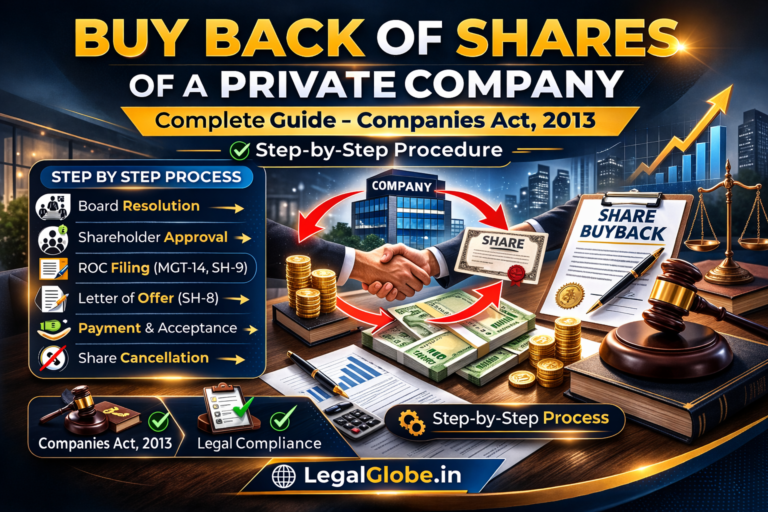
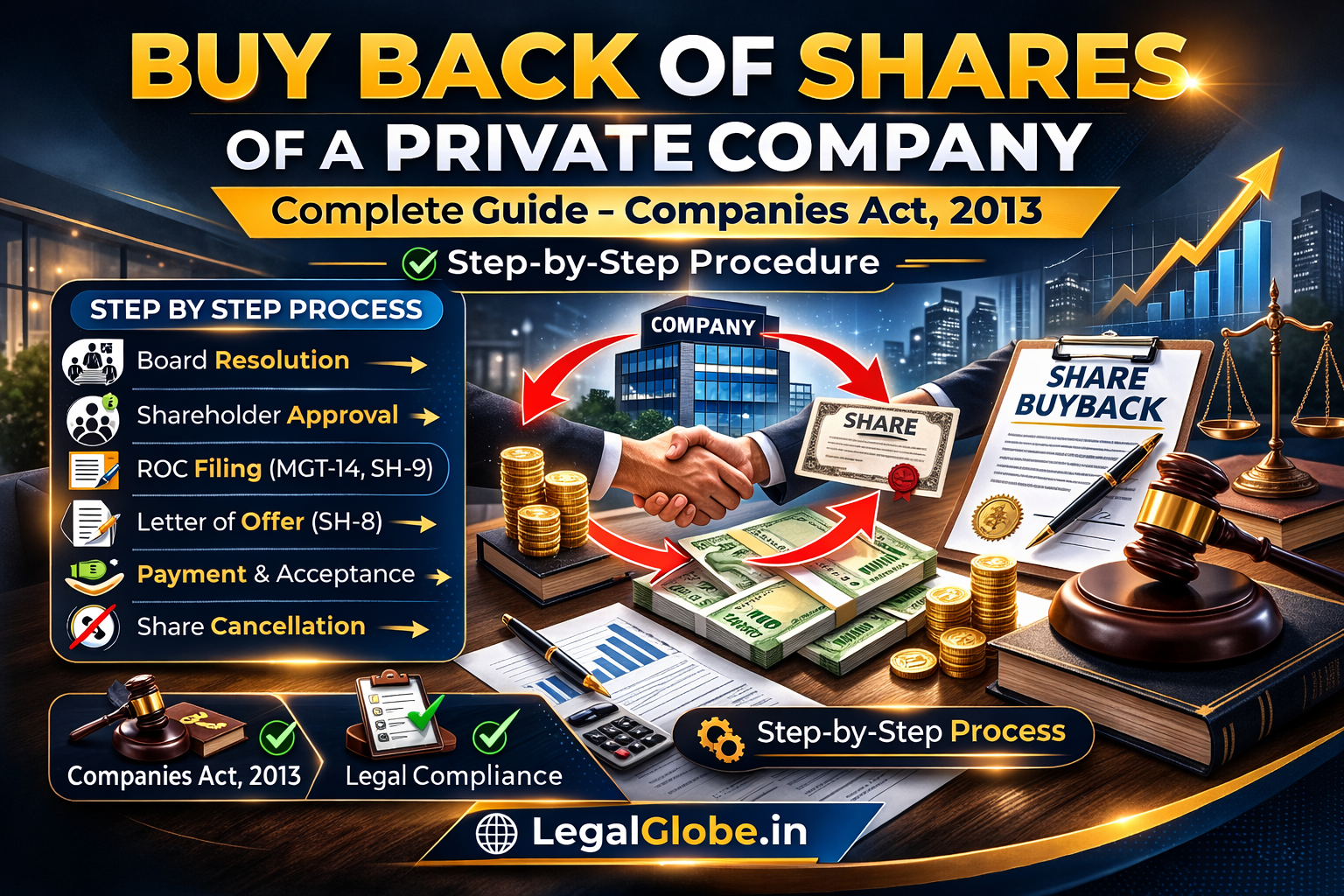
Buy Back Procedure – Step by Step
Below is the simplified procedure for buy-back of shares in a private company.
Step 1 – Check Articles of Association
Ensure that the AOA allows buy-back of shares.
If not, amend the AOA through a special resolution.
Step 2 – Board Meeting
The Board of Directors will:
- Approve buy-back proposal
- Decide number of shares to be bought back
- Approve draft notice of general meeting
Step 3 – Shareholder Approval
Shareholders must approve the buy-back through a Special Resolution.
If the buy-back amount is up to 10%, board approval alone is sufficient.
Step 4 – File Form MGT-14
The company must file Form MGT-14 with ROC within 30 days of passing the special resolution.
Step 5 – Declaration of Solvency
The company must file Form SH-9 declaring that it will remain solvent and capable of paying its liabilities.
Step 6 – Letter of Offer
Prepare Letter of Offer in Form SH-8 and send it to all shareholders.
Offer period must remain open for 15 to 30 days. Provided that where all members of a company agree, the offer for buy-back may remain open for a period less than fifteen days.
Step 7 – Open Separate Bank Account
The company must open a separate bank account and deposit the buy-back consideration.
Step 8 – Acceptance of Shares
Shareholders submit their shares for buy-back.
If more shares are offered than required, acceptance happens on proportionate basis.
Step 9 – Extinguishment of Shares
The bought-back shares must be extinguished within 7 days of completion.
Step 10 – Filing Return of Buy Back
The company must file Form SH-11 with ROC within 30 days after completion.
Buy Back Process Diagram
यह diagram readers को पूरा process जल्दी समझा देगा 👇
Board Meeting
      │
      ▼
Special Resolution (if required)
      │
      ▼
File MGT-14 with ROC
      │
      ▼
Declaration of Solvency (SH-9)
      │
      ▼
Letter of Offer to Shareholders (SH-8)
      │
      ▼
Open Separate Bank Account
      │
      ▼
Acceptance of Shares
      │
      ▼
Extinguishment of Shares
      │
      ▼
File Return of Buy Back (SH-11)
Post Buy Back Compliance
After completion of buy-back, the company must:
- Maintain Register of Buy Back in Form SH-10
- Transfer amount to Capital Redemption Reserve
- Update share capital in statutory records
When Buy Back is Not Allowed
A company cannot undertake buy-back if it has defaulted in:
- repayment of deposits
- redemption of debentures
- payment of dividend
- repayment of term loans
However, if the default is corrected and three years have passed, buy-back may be allowed.
Frequently Asked Questions (FAQs)
1. What is buy back of shares in a private company?
Buy back of shares refers to the process where a company purchases its own shares from its existing shareholders. After the purchase, the shares are cancelled or extinguished, which reduces the total number of shares in circulation and may increase the value of the remaining shares.
2. Which law governs buy back of shares in India?
The buy-back of shares in India is governed by the Companies Act, 2013, particularly Section 68, Section 69, Section 70, and Rule 17 of the Companies (Share Capital and Debentures) Rules, 2014.
3. Can a private limited company buy back its own shares?
Yes, a private limited company can buy back its own shares if it complies with the conditions and procedures prescribed under the Companies Act, 2013 and related rules.
4. What is the maximum limit for buy back of shares?
A company can buy back shares up to 25% of its paid-up capital and free reserves.
In case of equity shares, the buy-back in a financial year cannot exceed 25% of the paid-up equity capital.
5. Which forms are required for buy back of shares?
The following ROC forms are generally required during the buy-back process:
- MGT-14 – Filing of special resolution
- SH-9 – Declaration of solvency
- SH-8 – Letter of offer
- SH-10 – Register of buy back
- SH-11 – Return of buy back
6. What is the time limit to complete buy back of shares?
The buy-back process must be completed within one year from the date of passing the resolution authorizing the buy-back.
7. Can a company buy back partly paid shares?
No. A company can only buy back fully paid-up shares as per the provisions of the Companies Act, 2013.
Conclusion
Buy-back of shares is a powerful corporate restructuring tool that helps companies optimize their capital structure and return surplus funds to shareholders.
However, companies must carefully follow the provisions of the Companies Act and complete all statutory filings with the Registrar of Companies to ensure compliance.
Proper planning and adherence to legal requirements are essential for a successful buy-back process.
Disclaimer:
The information provided in this article is intended solely for general informational and educational purposes. While every effort has been made to ensure the accuracy and reliability of the content, the author and website do not guarantee that the information is complete, updated, or suitable for every situation. Readers are advised not to take any legal or professional action solely based on the information provided in this article. Before making any decision or undertaking any compliance activity, it is recommended to consult a qualified professional or legal advisor. The website shall not be responsible for any loss, liability, or consequences arising from the use of this information.
Related Legal Guides
If you are interested in corporate law and company compliance, you may also read the following guides:
- Private Limited Company Registration in India – Complete Process
- Documents Required for GST Registration in India
These guides will help entrepreneurs and professionals understand various compliance requirements under the Companies Act, 2013 and other business laws in India.
About the Author